
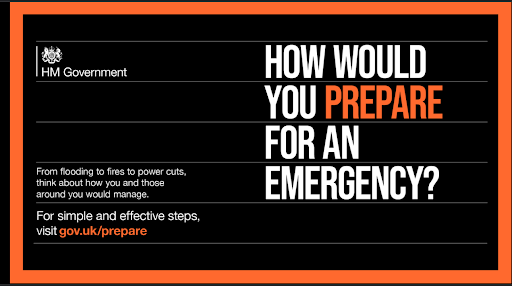
UK households are being encouraged to keep essential emergency supplies at home, including bottled water and non-perishable food, as the government steps up efforts to improve public preparedness for major disruptions.
Official guidance from the UK Government’s Prepare campaign advises people to consider what their households would need during an emergency lasting several days, such as a prolonged power cut, water outage or circumstances in which people are advised to remain at home or evacuate.
Recommended supplies include bottled drinking water, ready-to-eat food that does not require cooking, a battery-powered or wind-up torch, portable phone power bank, radio, spare batteries, first-aid supplies, essential medication and hygiene products.
The advice does not mean that an emergency is imminent, nor does it call on households to panic-buy. Instead, the government says people can gradually build up supplies over time as part of routine household preparedness.
How much water should households keep?
Government guidance points to a minimum of around 2.5 to 3 litres of drinking water per person per day for survival.
Around 10 litres per person per day would provide greater comfort by allowing additional water for basic cooking and hygiene.
Households may also need additional supplies for babies, pets or people who rely on medical equipment.
The guidance says the appropriate amount will vary depending on individual circumstances and the nature and duration of any emergency.
New figures show many households could be underprepared
The renewed attention on preparedness follows the publication of the UK Public Survey of Risk Perception, Resilience and Preparedness 2026 by the Cabinet Office on 19 August.
The nationally representative survey questioned more than 10,000 UK adults.
Although 37 per cent of respondents initially reported having enough bottled water to last three days, a more detailed assessment of the actual quantity stored produced a significantly different picture.
When household size and a benchmark of three litres of drinking water per person per day were taken into account, only 4 per cent of respondents were estimated to have enough bottled water to last their household for three days or longer.
The government found that 10 per cent would have enough for approximately one day, while 82 per cent would have less than one day’s supply.
Food preparedness appeared stronger.
Around 60 per cent of respondents said they had approximately three days of non-perishable food that did not require cooking.
Wider concerns over UK resilience
The advice comes against the backdrop of increasing government attention to the UK’s ability to withstand major national emergencies.
The National Risk Register 2026, published by the Cabinet Office in July and updated in August, sets out the government’s assessment of some of the most serious risks that could affect the United Kingdom and its interests.
The register covers a broad range of threats and hazards, including natural disasters, infrastructure disruption, major accidents and malicious attacks.
The government’s Prepare website explains that emergencies can arise from severe weather and other natural hazards, deliberate actions, accidents or infrastructure failure.
Some incidents may be resolved within hours, while others could disrupt communities and essential services for considerably longer.
What should an emergency kit contain?
The government recommends that households consider having:
* Bottled drinking water
* Non-perishable food that does not require cooking
* A manual tin opener where required
* Battery-powered or wind-up torches
* A battery-powered or wind-up radio
* Spare batteries
* A portable phone power bank
* A first-aid kit
* Essential medication
* Hand sanitiser and wet wipes
* Baby supplies where necessary
* Food and water for pets
People who depend on medical devices are also encouraged to keep instructions available and ensure backup batteries are charged where possible.
Households are advised to keep emergency supplies somewhere that can be found easily, including during a power cut.
Preparation, not panic
The government's advice emphasises practical preparation rather than stockpiling in response to any immediate threat.
People are specifically told that they do not need to purchase everything at once and can gradually add items to an emergency kit when they are able.
Authorities also encourage households to write down important telephone numbers, understand how to turn off household utilities, sign up for relevant emergency alerts and discuss emergency plans with family members.
The wider objective is to make households and communities more resilient should essential services be disrupted and to allow emergency services to concentrate resources on those most in need.
The White-eagles Post will continue to monitor official government guidance and any further developments relating to the UK's national resilience and emergency preparedness programme.