
Land restoration in Africa is being positioned as an investment priority at the UN Convention to Combat Desertification’s COP17 gathering in Ulaanbaatar, Mongolia, where participants have focused on ways to draw more finance into large-scale programmes.
COP17 is being held from 17 to 28 August 2026. Its agenda has included a dialogue designed to frame land restoration and drought resilience as economic and financial priorities, rather than solely as areas for support funding. The focus reflects a push to develop approaches capable of attracting capital for programmes that restore landscapes while strengthening the communities that depend on them.
African participants have called for action at landscape scale, alongside stronger land rights and community institutions. They have also highlighted the need for investment models that can attract finance. That combination places the structure of projects, local participation and the ability to secure capital alongside restoration goals.
Finance for rangelands has also featured in the COP17 programme. A 26 August dialogue on rangeland restoration and the well-being of pastoralist communities included identifying projects ready for investment and addressing the finance gap facing rangeland communities. The discussion brought attention to the practical challenge of turning restoration priorities into programmes that funders can support.
Susan Chomba of the World Resources Institute said public finance should be used to unlock private capital for long-term restoration investment, according to reporting from the gathering. Her comments aligned with the wider emphasis on financial mechanisms that can expand the resources available for restoration beyond public funding alone.
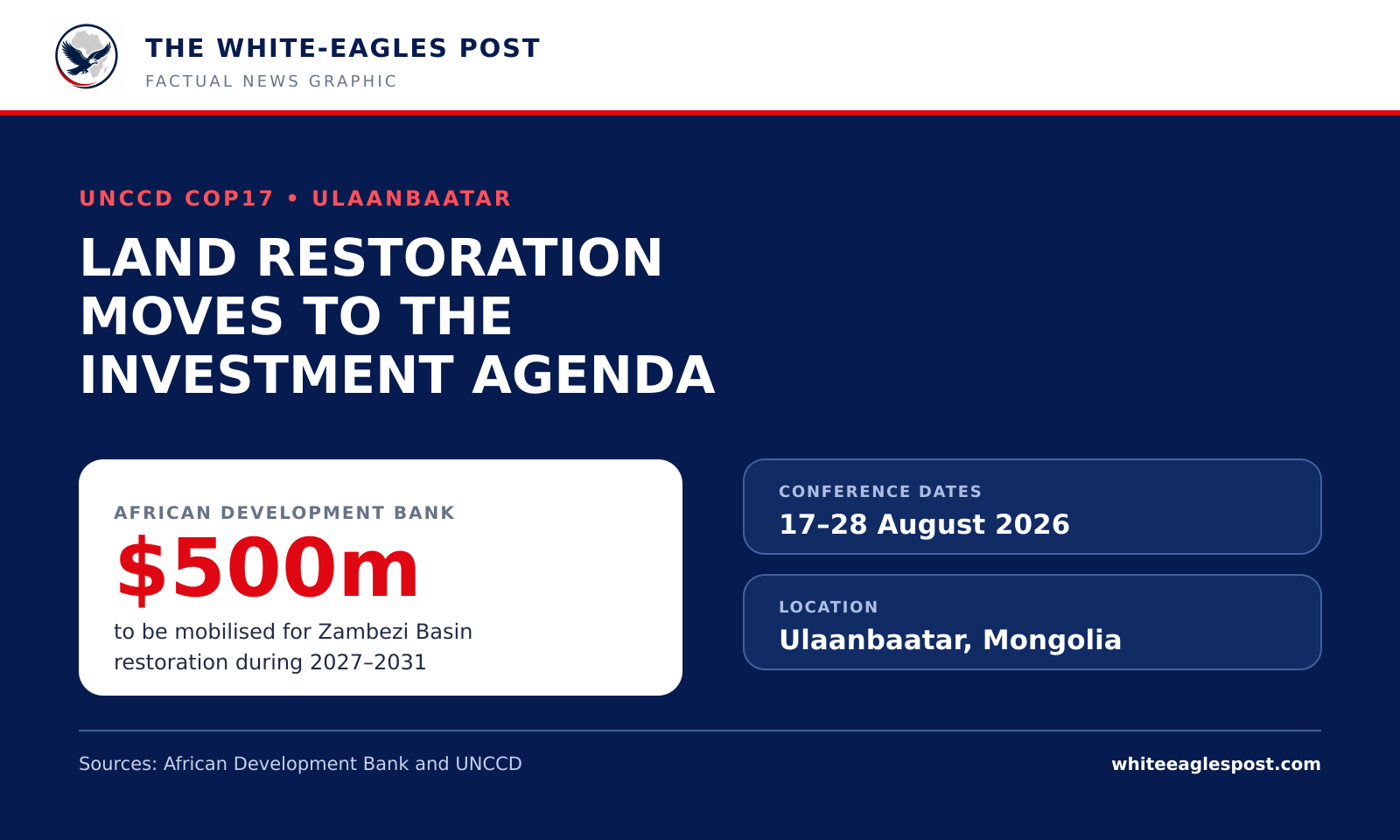
The African Development Bank has set out one concrete financing commitment during COP17. On 26 August, it announced that it would mobilise $500 million for the Zambezi River Basin restoration programme over the 2027–2031 period. The commitment provides a defined funding figure and timetable for a restoration programme linked to the broader financing discussions.
The COP17 discussions have therefore connected several elements of an investment-led approach: landscape-scale programmes, land rights, community institutions, projects prepared for finance, public funding designed to draw in private capital and dedicated commitments for restoration. The African Development Bank’s planned $500 million mobilisation for the Zambezi River Basin programme is scheduled for 2027–2031.